

Understanding Heavy-Duty Industrial Grinders
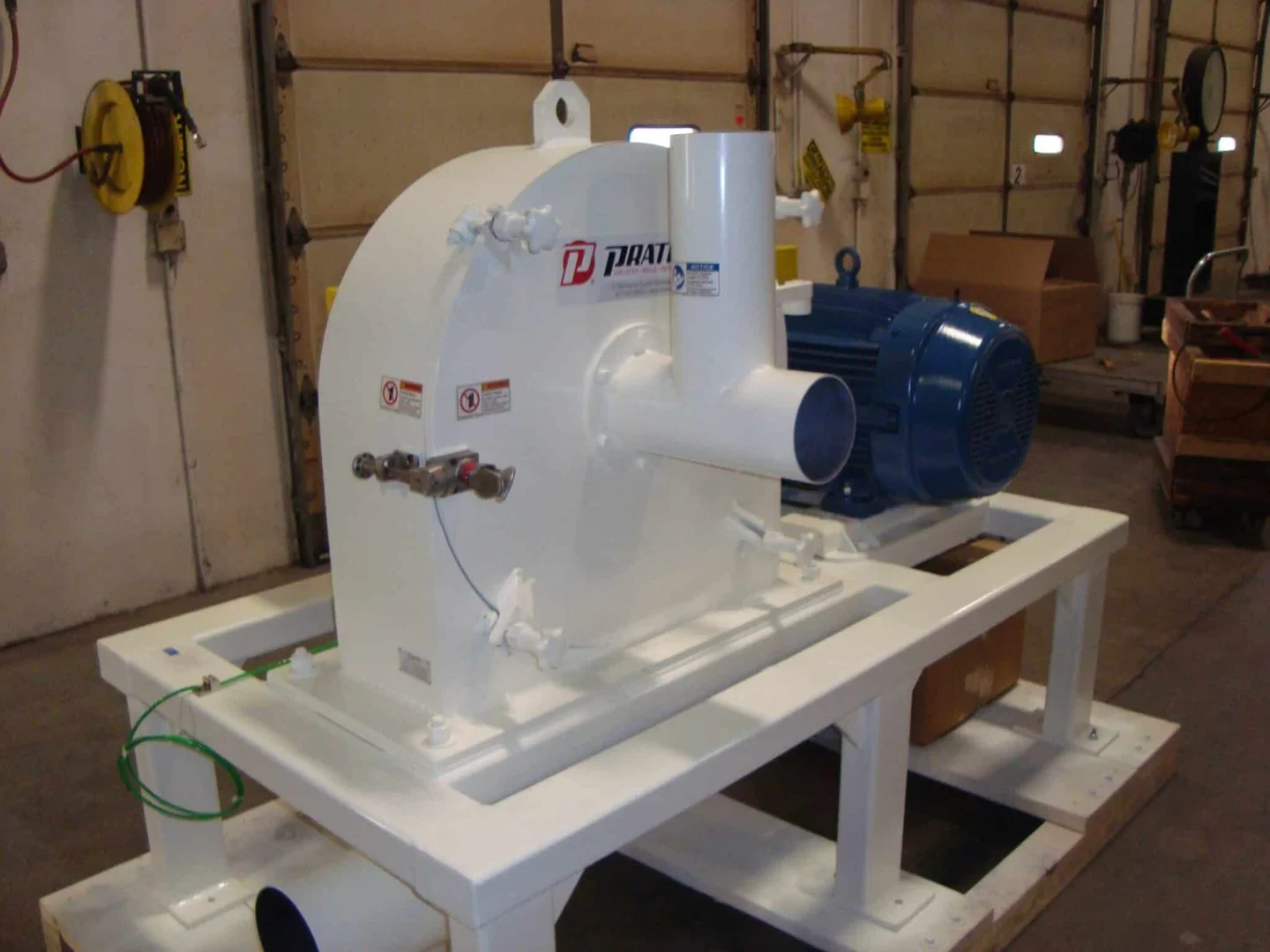
Heavy duty grinder equipment is essential for industrial operations requiring reliable particle size reduction. These machines process everything from food ingredients to construction materials, using powerful motors and specialized grinding components to break down bulk materials into precise particle sizes.
Quick Comparison of Industrial Grinder Types:
| Grinder Type | Best For | Typical Output | Key Feature |
|---|---|---|---|
| Fine Grinders | Ultra-fine powders (20-200 mesh) | Confectioners sugar, spices | Precision particle control |
| Hammer Mills | General purpose grinding | Wood chips, grains, plastics | High-speed impact reduction |
| Lump Breakers | Breaking clumps and agglomerates | Fertilizers, minerals | Gentle size reduction |
| Shredders | Pre-processing bulky materials | Pallets, demolition debris | Large feed opening |
Industrial grinders range dramatically in scale. You'll find compact units processing several pounds of material per minute with fractional horsepower motors, as well as massive horizontal grinders delivering over 1,000 horsepower for land clearing operations.
Power matters. A high-powered concrete grinder with a motor over 2000W can deliver double the removal rate of standard angle grinders. For any heavy-duty application, motor specifications directly impact throughput and efficiency.
Most industrial operations need consistent performance over extended periods. That's why features like brushless motors (lasting up to 10 times longer than conventional motors), overload protection, and integrated dust control systems are standard in modern heavy-duty grinders.
A Grinder for Every Job: Common Types of Heavy-Duty Grinders
There's no universal grinder. The machine that creates silky-smooth confectioners sugar won't be the same one breaking down wood pallets. That's why we've developed a complete range of heavy duty grinder solutions at Prater Industries—each one purpose-built for specific materials and applications.
Let's walk through the main types of industrial grinders.
Fine Grinders
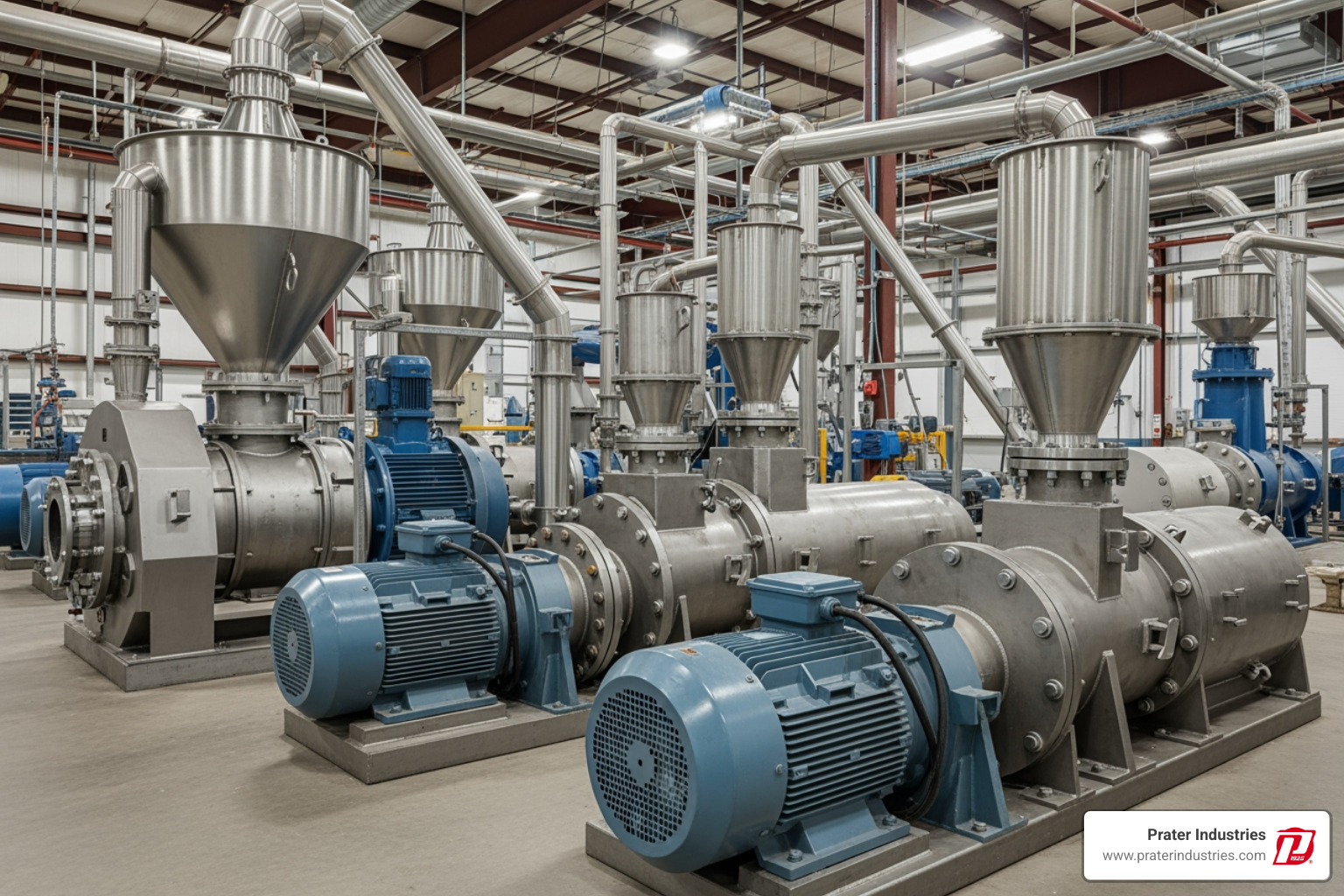
When your process demands precision particle sizes in the 20 to 200 mesh range, our Fine Grinders are the solution. They excel at creating ultra-fine, uniform powders for products like confectioners sugar, pharmaceuticals, and chemical additives, where consistency is critical. Our fine grinders use carefully engineered components to give you complete control over the final product.
Hammer Mills
If fine grinders are precision instruments, Hammer Mills are the versatile powerhouses of industrial grinding. These machines use high-speed impact to break down a wide variety of materials—grains, wood chips, plastics, and minerals. Built tough for high-volume production, their final particle size can be adjusted by changing screens or rotor speeds, making one heavy duty grinder adaptable for multiple product lines.
Lump Breakers
Sometimes material just needs to stop clumping. Lump breakers specialize in gentle but effective size reduction, breaking apart agglomerates in materials like fertilizers, chemicals, and certain food products. Instead of pulverizing, they keep material flowing smoothly, which means fewer blockages, less downtime, and consistent product quality.
Rotary Airlock Feeders
Feeders are critical teammates for grinders in pneumatic conveying systems. Rotary airlock feeders deliver a controlled stream of material into your grinder while maintaining an air seal. This prevents product loss, stops contamination, and keeps your entire system running efficiently. They are the unsung heroes that ensure your grinding equipment performs at its best.
Shredders for Pre-Processing
When materials are too big or tough to feed directly into a grinder, a shredder does the heavy lifting first. Industrial shredders feature large feed openings and powerful cutting mechanisms to tear apart bulky items like wood pallets, demolition debris, and large plastic components. Pre-processing with a shredder protects your downstream equipment and makes the entire grinding process more efficient.
Decoding the Specs: Key Features to Look For
When investing in a heavy duty grinder, understanding the technical specifications is essential. These specs tell you how a machine will perform, how long it will last, and whether it can deliver the results you need.
Power Source and Motor Type
The foundation of any industrial grinder is its power system. Most of our heavy duty grinder equipment runs on electricity (220V or higher) for consistent, reliable performance. The motor itself makes all the difference. Modern brushless motors are far more dust-resistant and can last up to 10 times longer than conventional brushed motors, meaning less downtime and more years of service.
Horsepower (HP) and Revolutions Per Minute (RPM)
Horsepower (HP) is your grinder's muscle, with commercial units starting around 1.8kW and massive industrial systems delivering over 1000 HP. More horsepower lets you process harder materials faster. Revolutions Per Minute (RPM) is about speed. Higher RPMs, which can range from 1,500 to over 11,000, typically lead to quicker reduction and finer particles, especially in impact mills. The ideal HP and RPM depend on your material and target particle size.
Throughput Capacity
Throughput capacity tells you how much material your grinder can process in a given time. This number is critical for determining if the equipment can keep pace with your production demands. The range varies dramatically from a few pounds per minute in smaller units to hundreds of tons per hour in large industrial systems. Matching throughput to your production goals is essential for maintaining efficiency.
Grinding Chamber Size and Components
The grinding chamber's design is critical. A larger feed opening—some industrial models are as large as 50 x 66 inches—allows you to process bulky materials without extensive pre-processing. The components inside are equally important:
- Grinding plates in our fine grinders create precise friction and shear, delivering the ultra-fine powders needed for applications like confectioners' sugar. Learn more in our article on Particle Size Reduction with Fine Grinders.
- Screens in hammer mills use specific hole sizes to control the final particle output, ensuring consistent results.
- Rotor and anvil systems in large systems are built from hardened materials like AR 450 steel to pulverize the toughest materials.
- Specialized wheels and heads are needed for tasks like concrete grinding, with sizes depending on the material and desired finish.
For a comprehensive look at all our solutions, check out A Comprehensive Guide to Prater's Particle Size Reduction Equipment.
Safety and Durability Features
Modern heavy duty grinder systems include multiple protective features. Overload protection prevents motor damage, while quick-stop functions halt components within seconds to reduce injury risk. Integrated dust control keeps the work environment safe. We build our equipment to last, using 304 stainless steel for food-grade applications or reinforced steel with wear liners for heavy industrial use. Our commitment to Prater Industries Reliability and Durability in Industrial Equipment is evident in every component.
Heavy-Duty Grinders in Action: Top Industrial Applications
Walk into almost any industrial facility, and you'll likely find a heavy duty grinder hard at work. These versatile machines are indispensable across countless industries, turning raw materials into usable products and waste streams into valuable resources.
Food Processing
In food manufacturing, precision is everything. The texture of cereals, the smoothness of powdered sugar, and the consistency of spices all depend on particle size reduction. Our heavy duty grinder systems are used for a wide range of tasks, from grinding meat to creating ultra-fine powders. For products like confectioners' sugar, our fine grinders provide the absolute consistency needed, as detailed in our article on Ultra-Fine Grinders for Confectioners Sugar Manufacturing. This precision is also vital for spices, supplements, and other ingredients where particle size affects quality.
Construction Materials and Surface Preparation
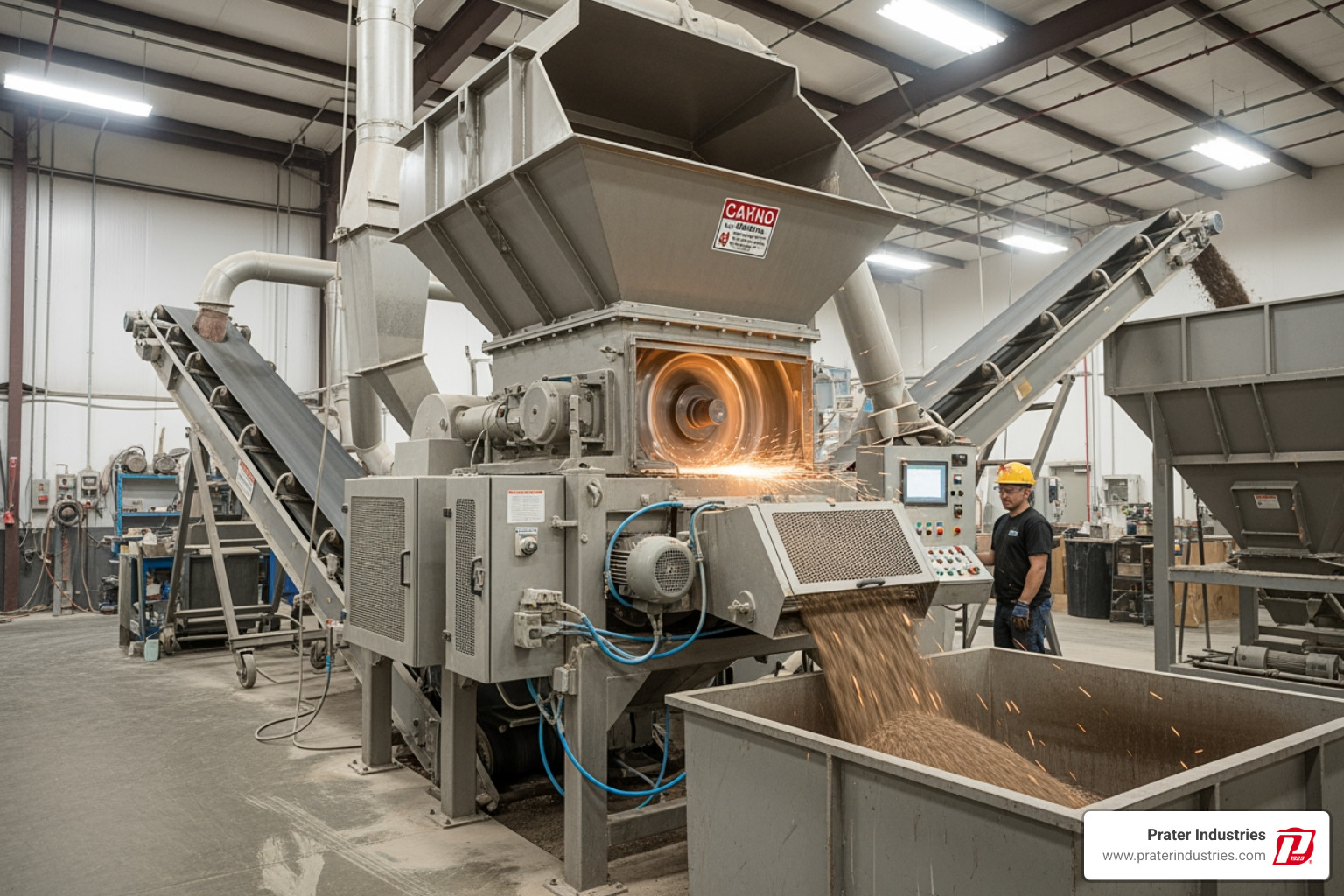
Construction sites present tough grinding challenges. Powerful concrete grinders with high-wattage motors can double removal rates compared to standard angle grinders, making quick work of surface preparation. These machines remove old coatings, roughen surfaces for better adhesion, and prepare floors for new finishes. Beyond surface prep, industrial shredders and horizontal grinders tackle demolition debris, breaking down concrete, rebar, and mixed materials for recycling or disposal.
Waste Management and Recycling
Massive horizontal grinders designed for waste management can process whole trees, stumps, pallets, and even contaminated demolition debris. With feed openings as large as 50 x 66 inches, these machines can swallow materials that would challenge other equipment. This versatility transforms waste management, turning disposal problems into revenue opportunities by preparing materials for composting, mulching, or energy generation.
Wood Processing
The wood products industry relies on grinding equipment at every stage. Sawmills use hammer mills to convert wood chips and residue into consistent particles for animal bedding, mulch, or biomass fuel. For land clearing, powerful track-mounted horizontal grinders process logs and stumps, improving mobility and reducing material handling costs with engines delivering over 1000 horsepower.
Agriculture
Modern farms use heavy duty grinder equipment to maximize efficiency. Hammer mills process feed grains and hay into optimal particle sizes for livestock digestion, improving feed conversion rates. Grinders also prepare organic matter like corn stalks and wheat straw for composting and soil amendments, handling high-volume, abrasive materials with the reliability that busy farms demand.
Mining and Mineral Processing
Mining operations require grinders built for the most punishing conditions. Processing hard, abrasive ores and minerals to fine particles for extraction demands extreme durability. In these environments, wear resistance is critical. The low-maintenance design philosophy we bring to all our equipment is especially valuable in remote mining locations where downtime is costly.
Metal Powders
The production of metal powders for additive manufacturing and specialized coatings requires exceptionally precise particle control. Fine grinders process various metals into powders with specific particle size distributions, ensuring consistent performance in demanding applications. This precision grinding often requires specialized dust control and safety systems.
How to Choose the Right Heavy-Duty Grinder
Selecting the ideal grinder is a critical decision that impacts efficiency, product quality, and your bottom line. It's about finding the right machine for your specific application and material characteristics. At Prater Industries, we guide clients through a comprehensive evaluation to ensure the best fit.
Application Assessment
The first step is a thorough application assessment. Start by defining your:
- Material Properties: Is the material hard, soft, fibrous, abrasive, or moist? Its characteristics will dictate the grinder type.
- Desired Particle Size: Do you need a coarse grind or an ultra-fine powder? This will steer you toward a specific technology, like a fine grinder or hammer mill.
- Throughput Requirements: How much material do you need to process per hour? This determines the grinder's required capacity and power.
- Contamination Concerns: Does your material contain foreign objects like tramp metal? Some grinders include metal detection to protect the machine.
- Process Integration: How will the grinder fit into your existing production line, including feeding, discharge, and dust collection?
Our Guide to Choosing the Right Fine Grinder Mill for Your Application offers deeper insights into this process.
Evaluating Power and Portability for a heavy-duty grinder
For most industrial applications, electric grinders are the standard, offering consistent power crucial for maintaining throughput. Our Prater equipment is designed for industrial electric power (220V or higher), ensuring reliability. Your facility's infrastructure, including electrical connections and material handling systems, plays a significant role in grinder selection. While many of our industrial grinders are stationary, their design facilitates ease of installation within existing facility layouts in Illinois, across the US, and in Canada.
Factoring in Cost and Long-Term Value for a heavy-duty grinder
The price of an industrial grinder is just one part of the equation. To make a smart investment, you must consider the total cost of ownership (TCO) and long-term value.
Initial Cost vs. TCO: The upfront price for grinders varies from a few thousand dollars for commercial units to six figures for large-scale industrial systems. However, a lower initial cost can be misleading. TCO includes operational costs, maintenance, energy use, and downtime. At Prater Industries, our focus on low-maintenance, reliable systems means a lower TCO over the machine's lifespan.
Maintenance, Durability, and Reliability: A grinder designed for easy maintenance—with features like removable heads and bolt-in wear liners—minimizes costly downtime. Durability, achieved through robust materials like 304 stainless steel or reinforced steel, ensures the machine withstands demanding operations. This commitment to Prater Industries Reliability and Durability in Industrial Equipment means you get consistent output and predictable performance.
Operational Efficiency: An efficient grinder maximizes output while minimizing energy use. Features like optimized motor designs and effective material feeding systems reduce waste, improve product consistency, and lower utility bills, contributing directly to your bottom line.
Maximizing Performance: Safety, Maintenance, and Modern Tech
Getting the most from your grinder requires a strategy that prioritizes safety, maintenance, and technology. At Prater Industries, we've learned that peak performance comes from this interconnected approach.
Safety First, Always
Industrial grinding equipment is powerful and demands respect. Comprehensive safety protocols are fundamental to responsible operation.
- Personal Protective Equipment (PPE): Safety glasses, hearing protection, and proper gloves and footwear are your first line of defense. Respiratory protection is essential when grinding materials that create fine dust.
- Machine Safety Features: Modern heavy duty grinder systems incorporate features like quick-stop buttons to halt components in seconds and overload protection to prevent motor damage and dangerous situations.
- Lockout/Tagout: Before any maintenance, proper lockout/tagout procedures must be followed. The machine must be completely de-energized to prevent accidental startup.
Controlling the Dust
Effective dust control protects operator health, prevents product contamination, and reduces fire or explosion risks. Many grinders feature integrated dust hoods that connect to a collection system. At Prater, we design many of our systems as fully enclosed units, minimizing dust escape at the source. Proper facility ventilation works with localized collection to maintain clean, safe air.
The Maintenance Mindset
Consistent maintenance is about preventing breakdowns and maintaining performance. Our low-maintenance systems make upkeep as straightforward as possible.
- Regular Cleaning: Prevents material buildup and improves efficiency. Features like removable grinding head assemblies simplify this task.
- Wear Parts Inspection: Routinely check screens, hammers, and blades. Quick-change systems and bolt-in liners minimize replacement downtime.
- Lubrication and System Checks: Follow manufacturer guidelines for lubricating bearings and checking belt tension and electrical systems to ensure smooth, safe operation.
Embracing Modern Technology
New technologies are making grinders more efficient, easier to operate, and longer-lasting.
- Brushless Motors: These last up to 10 times longer than conventional motors and resist dust better, reducing maintenance and extending equipment life.
- Smart Controls: Modern systems can monitor performance, optimize processes, and send predictive maintenance alerts.
- Interchangeable Components: Some grinders can swap rotor configurations to handle different materials, increasing versatility.
- Advanced Materials: High-strength, abrasion-resistant steels in wear parts significantly extend component life.
For applications requiring precise particle distribution, it's important to understand the differences between technologies, like the distinction we explore in Fine Grinders vs. Air Classifying Mills.
Conclusion
Choosing the right industrial grinder is a critical decision. This guide has covered the essential factors, from grinder types and key specifications to industrial applications and long-term value.
We've explored how different machines—like our precise fine grinders, versatile hammer mills, and gentle lump breakers—are engineered for specific tasks. Understanding your material, desired particle size, and throughput goals is the first step. Key specs like horsepower and RPM directly influence performance, while modern features like brushless motors improve reliability.
The right grinder is a long-term investment. That's why we emphasize looking beyond the initial price to the total cost of ownership. At Prater Industries, our focus on low-maintenance, reliable systems ensures you get durable equipment that delivers operational efficiency for years. By combining this with rigorous safety protocols and consistent maintenance, you can maximize performance and protect your investment.
For decades, Prater Industries has helped businesses across Illinois, the US, and Canada find the perfect particle size reduction solutions. Our commitment includes expert on-site technical services and ongoing support to ensure your success.
Ready to find the perfect grinding solution for your operation? Explore our range of industrial hammer mills for your particle reduction needs. Our team is here to help you select the heavy duty grinder that's exactly right for your application.