

Particle Size Reduction: Turning Material Challenges into Process Profits
In modern manufacturing, particle size reduction, often called comminution, is the foundation of product quality. Whether you are producing pharmaceutical powders, food ingredients, or high-performance polymers, the goal is to transform bulk solids into a specific, narrow size range to ensure consistent downstream performance.
At Prater Industries, we’ve spent 100 years refining the science of Particle Size Management to help operators move past the bottlenecks of traditional milling.
1. The Physics of Fracture: How Materials Break
Particle size reduction is essentially the management of internal stress. To break a solid, you must apply enough mechanical energy to overcome its internal bonding forces.
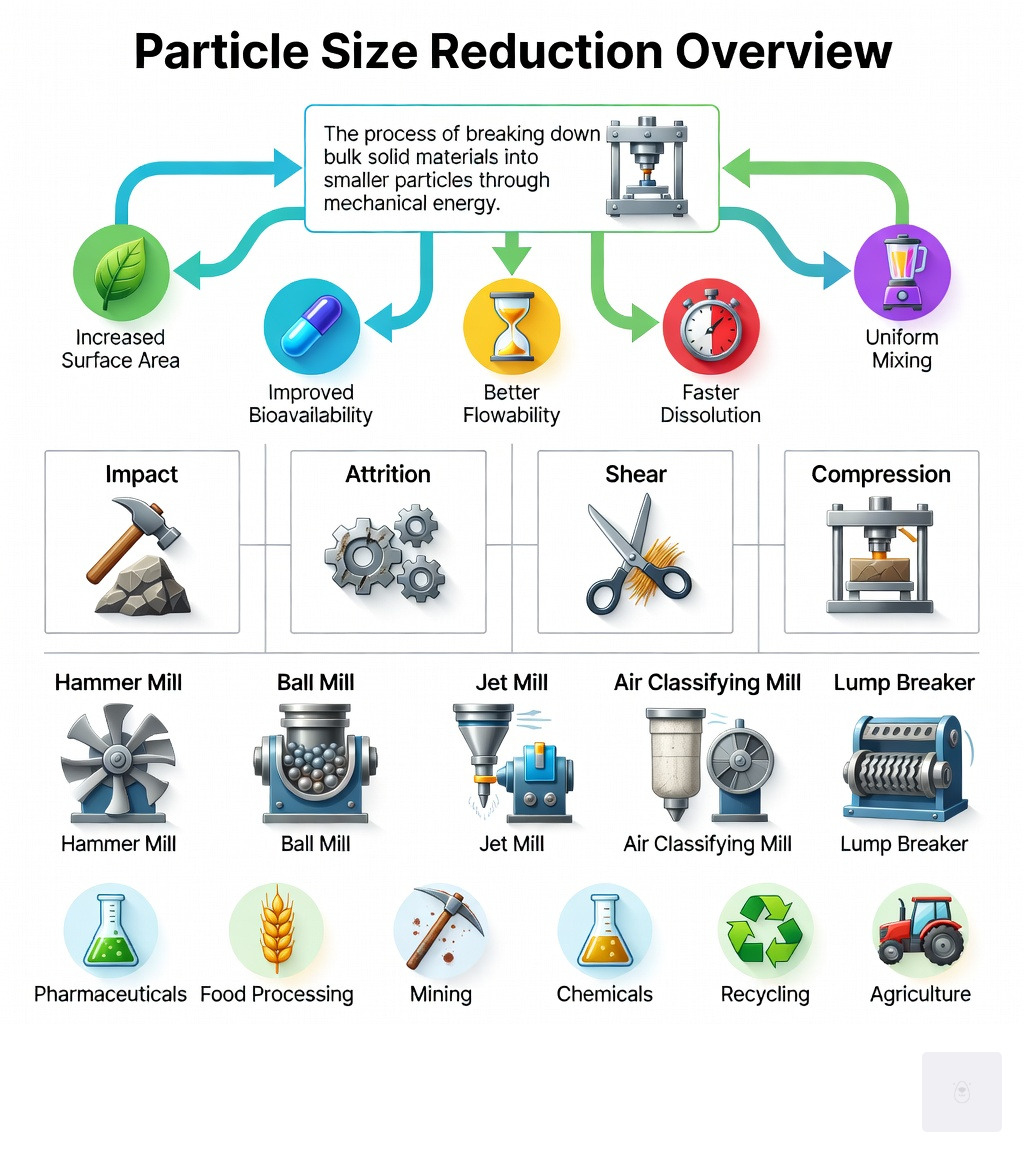
The Four Mechanical Forces
Most industrial mills rely on one (or a combination) of these four physical actions:
- Impact: High-speed collision between the material and a moving part (e.g., a hammer). Best for brittle materials that "shatter."
- Attrition: Particles rubbing against each other or an abrasive surface. This creates very fine powders through "wear."
- Shear: A slicing action, similar to scissors. Essential for ductile or fibrous materials that would otherwise "smear" rather than break.
- Compression: Squeezing the material between two hard surfaces. Primarily used for coarse crushing of very hard minerals.
2. Material Properties: The Decision Matrix
Before selecting equipment, an operator must categorize the material based on its physical "behavior" under stress. This prevents the common mistake of applying the wrong force to a sensitive material.
Hardness and Abrasiveness (The Mohs Scale)
A material’s hardness dictates the wear rate of your machinery and the frequency of maintenance shutdowns.
- Soft (Mohs 1-3): Talc, Gypsum, Grains.
- Medium (Mohs 4-6): Limestone, Corn, some Chemicals.
- Hard/Abrasive (Mohs 7+): Silica, Glass, Quartz.
Friability vs. Ductility
- Friable materials are brittle and easy to shatter (e.g., dried sugar).
- Ductile materials are "rubbery" and absorb impact (e.g., certain plastics).
- Operational Tip: For ductile materials, you may need Cryogenic Milling, which uses liquid nitrogen to cool the material below its "glass transition point," making it brittle enough to fracture.
Proof in Production: Theoretical physics is best validated by real-world results. For instance, see how we managed high-fat challenges in our Case Study: Cocoa Sifting and Fat Management, or how we optimized throughput for moist materials in our Case Study: Pet Food and Soy Flake Grinding. If you are dealing with high-wear materials, our Case Study: Abrasive Charcoal Applications demonstrates how specialized alloys extend equipment life.
3. Comparing Industrial Milling Technologies
Choosing a mill is a balance of throughput (lbs/hr), target micron size, and heat sensitivity.
| Mill Type | Primary Action | Typical Output | Best For |
|---|---|---|---|
| Hammer Mill | Impact | 42 - 300 Mesh | Grains, Fibrous materials, General Chemicals. |
| Fine Grinder | Impact/Attrition | 200 - 400 Mesh | Sugar, Flour, Fine Chemicals. |
| Air Classifying Mill | Impact + Air Flow | Down to 5 Microns | Heat-sensitive items, Ultra-fine powders. |
| Jet Mill | Fluid Energy | 0.5 - 10 Microns | High-purity pharma, highly abrasive items. |
Technical Deep-Dive: For detailed mechanical specifications, clearance tolerances, and motor configurations, View Prater’s Full Product Literature & Technical Data Sheets to access the specific PDF manuals for our CLM-18 Lab Systems, Hammer Mills, and Fine Grinders.
4. Solving the "Efficiency Gap"
Milling is one of the most energy-intensive processes in the world. Approximately 95% of the energy used in a mill is lost to heat and vibration. To optimize OEE (Overall Equipment Effectiveness), you must manage these variables:
Heat Management
Heat is the primary enemy of fine grinding. As particles get smaller, their surface area increases, which can lead to melting or "fatting out."
- The Air-to-Cloth Ratio: Proper dust collection allows the mill to "breathe," pulling heat away from the grinding chamber.
- Screen Area vs. Horsepower: A larger screen area allows "ready" particles to exit immediately, preventing "over-grinding" which generates unnecessary thermal energy.
Moisture and "Blinding"
If a material’s moisture content exceeds 5%, it often becomes "hygroscopic" (clumps easily). These clumps "blind" the screen, meaning they plug the holes and stop production entirely.
5. Quality Control: Measuring the Result
In a modern production environment, "fine" isn't a measurement. We use Particle Size Distribution (PSD) to ensure the majority of your product falls within a "narrow curve."
- Sieve Analysis: The traditional method using stacked mesh screens. Good for coarse powders.
- Laser Diffraction: The digital "gold standard." It identifies "overs" (gritty bits) and "fines" (dust) in seconds, allowing for real-time process adjustments.
6. Safety: Managing the Explosion Risk
Fine powders have massive surface areas, making many of them highly combustible. Plant owners must ensure systems meet NFPA or VDI standards.
- Venting: Systems must include explosion relief panels to safely vent pressure.
- Inerting: For highly volatile powders, the system is flooded with Nitrogen to remove the oxygen required for combustion.
7. Operational Reliability: Maintenance for Peak Performance
The difference between a system that lasts 10 years and one that lasts 40 is a proactive maintenance strategy. Because particle size reduction relies on high-speed mechanical energy, wear is inevitable, but it should never be a surprise.
Wear Parts and Performance Drift
As hammers, pins, or liners wear down, the "sharpness" of the impact decreases. This leads to performance drift, where the mill consumes more power to achieve the same particle size.
- The 80% Rule: We recommend replacing wear components once they lose roughly 20% of their original mass or edge profile. Beyond this point, the increased energy costs usually exceed the cost of the replacement parts.
- Balancing: High-speed rotors must be precision-balanced. Even a few grams of material buildup or uneven wear can cause vibration that damages bearings and seals.
Sanitation and Accessibility
For owners and operators, the "Ease of Access" determines how quickly a line can be turned around between batches.
- Cantilevered Shafts: Modern designs allow the rotor to be accessed without disturbing the bearings or drive-train. This is a game-changer for food and pharma industries requiring frequent washdowns.
- Tool-less Inspection: Look for systems that allow for screen and liner inspections without requiring a full maintenance crew. If a screen change takes two hours instead of ten minutes, your OEE is leaking profit.
Maintenance Resources: Transparency in equipment care is the foundation of machine longevity. To help your team develop a proactive service schedule, you can Access Prater Equipment Manuals and Maintenance Guidelines directly through our technical manual library.
Predictive vs. Reactive Maintenance
A 100-year legacy in this industry has shown us that "running to failure" is the most expensive way to operate.
- Vibration Monitoring: Sensors can detect bearing fatigue weeks before a failure occurs.
- Temperature Tracking: Monitoring the delta between feed temperature and discharge temperature can signal when a screen is starting to blind or a motor is overworking.
Conclusion: Bridging the Gap Between Physics and Profit
Mastering industrial particle size reduction is not a "set it and forget it" task. It is a continuous balance of material science, mechanical precision, and operational discipline. As we’ve explored, achieving a consistent finish, whether it’s a 75-micron food ingredient or a sub-44 micron chemical, requires more than just a motor and a blade. It requires a system designed to win the fight against heat, moisture, and mechanical wear.
When a milling circuit is truly optimized, the results are felt across the entire facility. Success is found in the predictable fracture of a brittle material, the energy saved by a high-efficiency motor, and the peace of mind that comes from a safe, reliable floor.
Moving Beyond "Good Enough"
The most expensive mistake in milling isn't a broken component; it’s a system that is "good enough" while slowly draining profits through energy waste, frequent screen blinding, or inconsistent product quality. If you are struggling with a difficult material or a bottlenecked process, the solution usually lies in the data.
Don't leave your equipment configuration to chance. Use these principles to audit your current line:
- Evaluate your mechanical forces against your material's hardness.
- Audit your maintenance intervals to catch performance drift before it stops production.
- Validate your results with precise distribution testing to ensure you are meeting your customers' exact specs.
Ready to Optimize Your Process?
The best way to find the right solution for your specific application is through local expertise and hands-on testing. Our network of specialized manufacturing representatives is ready to help you evaluate your facility's needs and navigate the complexities of particle engineering.
Find your local Prater Representative here to schedule a technical consultation or a material trial in our test lab. Let's find your most efficient path to a 75-micron finish together.
About Prater Industries
At Prater Industries, we specialize in providing particle size reduction solutions that are reliable, low-maintenance, and tailored to your specific material. From our heavy-duty hammer mills to our precision air classifying mills, we build systems that stand the test of time.
If you are looking to optimize your processing line or are dealing with a difficult material, we are here to help. Our team provides on-site technical services and testing to ensure you get the exact particle size you need, every single time. Contact us today to learn how we can help you achieve industrial efficiency through better particle engineering.
Frequently Asked Questions: Industrial Particle Size Reduction
What is the most energy-efficient way to reduce particle size?
Efficiency is achieved by matching the mechanical force to the material's fracture point. For brittle materials, impact milling (Hammer Mills) is highly efficient. However, the most significant energy savings come from a "closed-loop" system where material is removed from the grinding chamber the moment it hits the target size, preventing "over-grinding" and wasted thermal energy.
How do I prevent screen blinding in fine powder processing?
Screen blinding occurs when moisture or fats cause particles to bridge across screen openings. This is best managed by using centrifugal force (Rotary Sifters) rather than gravity-fed vibratory screens. High-velocity paddles break up agglomerates and drive material through the mesh, while proper airflow keeps the material cool and dry.
What is the difference between Mesh size and Micron size?
Mesh refers to the number of openings in one linear inch of a screen (e.g., 200 mesh). Micron (µm) is a metric unit of length measuring the actual particle (1 micron = 1/1,000,000 of a meter). As the Mesh number increases, the Micron size decreases. For example, a 325 Mesh screen allows particles of approximately 44 microns to pass through.
When should I use an Air Classifier instead of a mechanical screen?
You should move to Air Classification when your target size is sub-44 microns (325 mesh) or when your material is highly abrasive. Because Air Classifiers use centrifugal air force instead of physical mesh, they eliminate the risk of screen breakage and provide a much "sharper" particle size distribution for ultra-fine powders.
How does moisture content affect milling performance?
Ideally, dry milling requires a moisture content below 5%. Higher moisture levels increase the "stickiness" of the material, leading to clumping, increased heat, and potential motor failure. For materials with high moisture or oil, cryogenic cooling or specialized air-swept mills are required to maintain flowability.
How often should mill hammers and liners be replaced?
Wear parts should be inspected regularly and typically replaced once they lose 20% of their mass or their sharp leading edge. Running worn components increases energy consumption and causes "particle drift," where your final product begins to lose its uniform size.