

Understanding Rotary Sifter Applications in Industrial Processing
A rotary sifter is a high-capacity screening machine that uses centrifugal force to separate materials by particle size, remove contaminants, and break up lumps in dry bulk powders, granules, and agglomerates. Also known as a rotary sieve, rotary screen, or centrifugal sifter, this equipment is essential for quality control and process efficiency across food processing, pharmaceutical, chemical, and bulk material handling industries.
Key Applications of Rotary Sifters:
- Scalping - Removing oversized particles and foreign materials (plastics, strings, insects) from bulk ingredients
- Sifting - Separating materials into specific particle size fractions (typically 1/4 inch to 200-mesh)
- De-agglomeration - Breaking down soft lumps and clumps in powders
- Safety screening - Protecting downstream equipment and ensuring product purity
- Pre-screening - Processing materials after silos or before mixing and packaging
If you're evaluating whether a rotary sifter fits your operation, you're likely dealing with challenges like inconsistent particle sizing, contamination concerns, or equipment that can't keep up with your throughput demands. Unlike vibratory screeners that rely on mechanical vibration, rotary sifters use spinning paddles to create centrifugal force that pushes material through a cylindrical screen. This results in higher capacity per square foot of screen area, reduced maintenance, and lower noise levels.
The Prater Rota-Sieve proves its cost efficiency daily across diverse applications, from removing foreign bodies in food ingredients to classifying pharmaceutical powders to processing recycled materials. With separation capabilities down to 200-mesh without anti-blinding mechanisms and throughput ranging from hundreds of pounds per hour to 100 tons per hour, these machines deliver reliable performance in compact footprints.
How Rotary Sifters Work: The Centrifugal Force Advantage
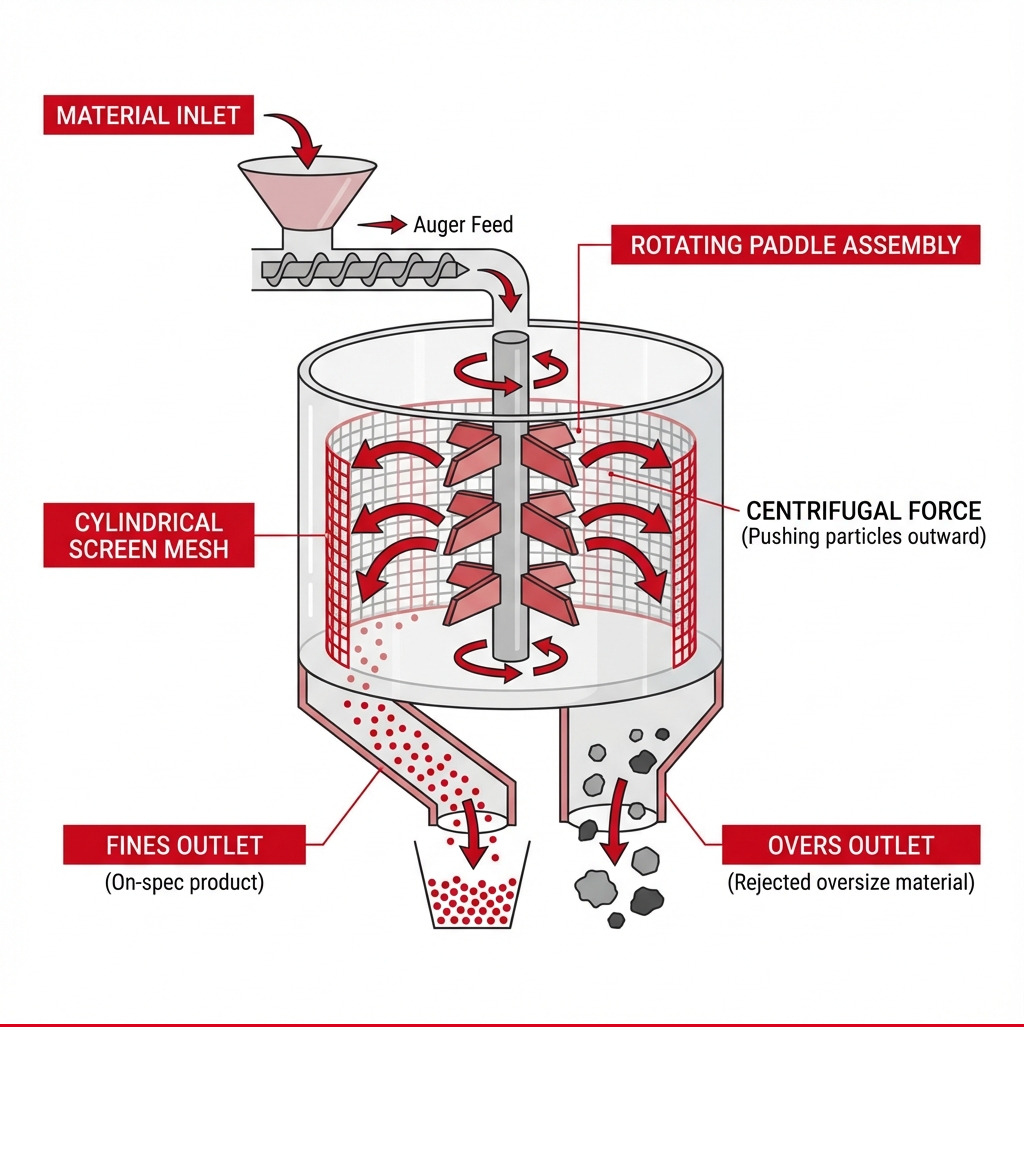
Imagine a whirlwind of efficiency at the heart of your material processing. That's essentially what a rotary sifter offers! Our rotary sifters, also known as centrifugal sifters, operate on a principle that leverages centrifugal force to achieve superior separation. It's a clever design that ensures high throughput and precise particle sizing.
The operational theory begins with the material infeed. Typically, an auger or feed screw introduces your product — be it powder, granules, or agglomerates — into the screening chamber. Once inside, a multi-paddle rotor takes over. These paddles rotate at high speeds, usually between 120-300 rpm, fluidizing the material and accelerating particles outward towards a cylindrical screen mesh. This rapid rotation creates the centrifugal force that is the real star of the show.
As the material is pushed against the screen, finer particles, or "fines," are forced through the mesh openings and collected as the on-spec product. Simultaneously, any larger particles, unwanted contaminants, or "overs," remain inside the cylindrical element and are discharged separately. This continuous, dynamic action also provides a powerful de-agglomeration effect, breaking down soft lumps and clumps in your product to improve yield and consistency. It’s an incredibly effective way to ensure that only material of the desired size makes it through, keeping your process running smoothly and your product quality high.
For a deeper dive into the mechanics, we invite you to explore our detailed explanation on How Centrifugal Sifters Work.
Key Components and Features
Our rotary sifters are engineered for performance and reliability, built with a suite of robust components and thoughtful features. At the core of the machine, we find the cylindrical screen, available in various mesh sizes to meet your specific separation needs. This screen is housed within a durable, often stainless steel, body designed for longevity and hygiene.
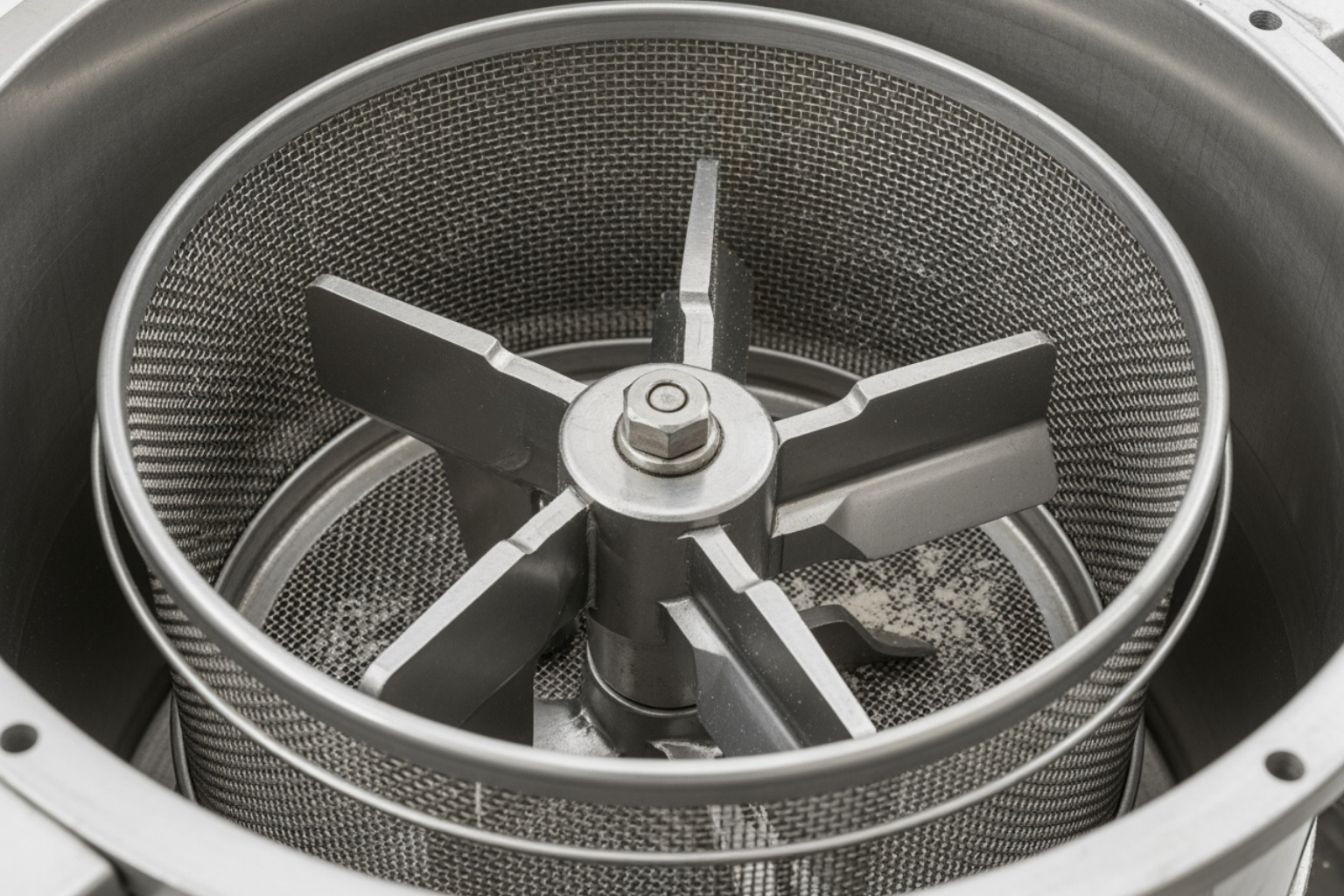
The rotor assembly, equipped with its multi-paddles, is crucial for generating the centrifugal force. This assembly is driven by a powerful motor, ensuring consistent high-speed rotation. Precision bearings support the rotor shaft, ensuring smooth operation and reducing wear. Many of our Prater Rota-Sieve® models feature a cantilever shaft design, which means the shaft is supported at only one end. This design dramatically simplifies maintenance and screen changes, as there's no need to remove bearings or seals from the discharge end.
To maintain a clean and safe working environment, our rotary sifters come with a dust-tight housing. This prevents product loss and safeguards operator health by containing airborne particles. The compact footprint of these machines, combined with their high throughput capacity, makes them an excellent choice for operations where space is at a premium but efficiency cannot be compromised. Features like easy inspection, rapid rotor removal, and tool-free access are built into our designs, making them a joy to operate and maintain.
Benefits Over Traditional Screening Methods
When considering particle separation equipment, it's easy to get lost in the options. However, rotary sifters consistently stand out, offering significant advantages over more traditional screening methods like vibratory screeners.
One of the most compelling benefits is their higher capacity per screen area. Our rotary sifters can achieve more throughput with a smaller footprint compared to other screening equipment on the market. This means you can process more material in less space, directly contributing to increased productivity.
Another major headache in traditional screening is screen blinding, where particles get stuck in the mesh, reducing efficiency and requiring frequent cleaning. Our rotary sifters virtually eliminate this issue. The continuous, high-speed action of the rotating paddles and the centrifugal force create a self-cleaning effect, preventing particles from lodging in the screen. This allows us to achieve separation down to 200-mesh size without the need for anti-blinding mechanisms, even with materials prone to flaking or agglomerating due to fat or moisture content.
Operator safety and comfort are also paramount. Our rotary screeners operate at a very low noise level and prevent dust leakage through their dust-tight assembly. This safeguards operator health and creates a more pleasant working environment. Plus, with features like our cantilever shaft design, cleaning and mesh changes become incredibly easy and quick.
For a deeper dive into how our rotary sifters stack up against other screening technologies, explore the Advantages of Rotary Sifter Machines and our comparative analysis on Sieving Techniques: Industrial Sieves vs. Rotary Sifters.
Core Applications of the Rotary Sifter Across Industries
The versatility of the rotary sifter makes it an indispensable tool across a vast array of industries. From ensuring the purity of your morning coffee creamer to fine-tuning the consistency of pharmaceutical ingredients, our machines play a critical role in quality control and process efficiency. Whether it's scalping, classifying, or sifting, these machines are designed to meet diverse industrial needs. They excel at contaminant removal, protecting downstream equipment, and guaranteeing the integrity of your final product.
For a comprehensive look at how these machines can benefit various operations, check out our insights on Centrifugal Sifters Applications & Benefits.
Food and Beverage Processing
In the food and beverage industry, precision and hygiene are not just buzzwords; they are absolute necessities. Our rotary sifters are vital for maintaining the highest standards of product quality and safety.
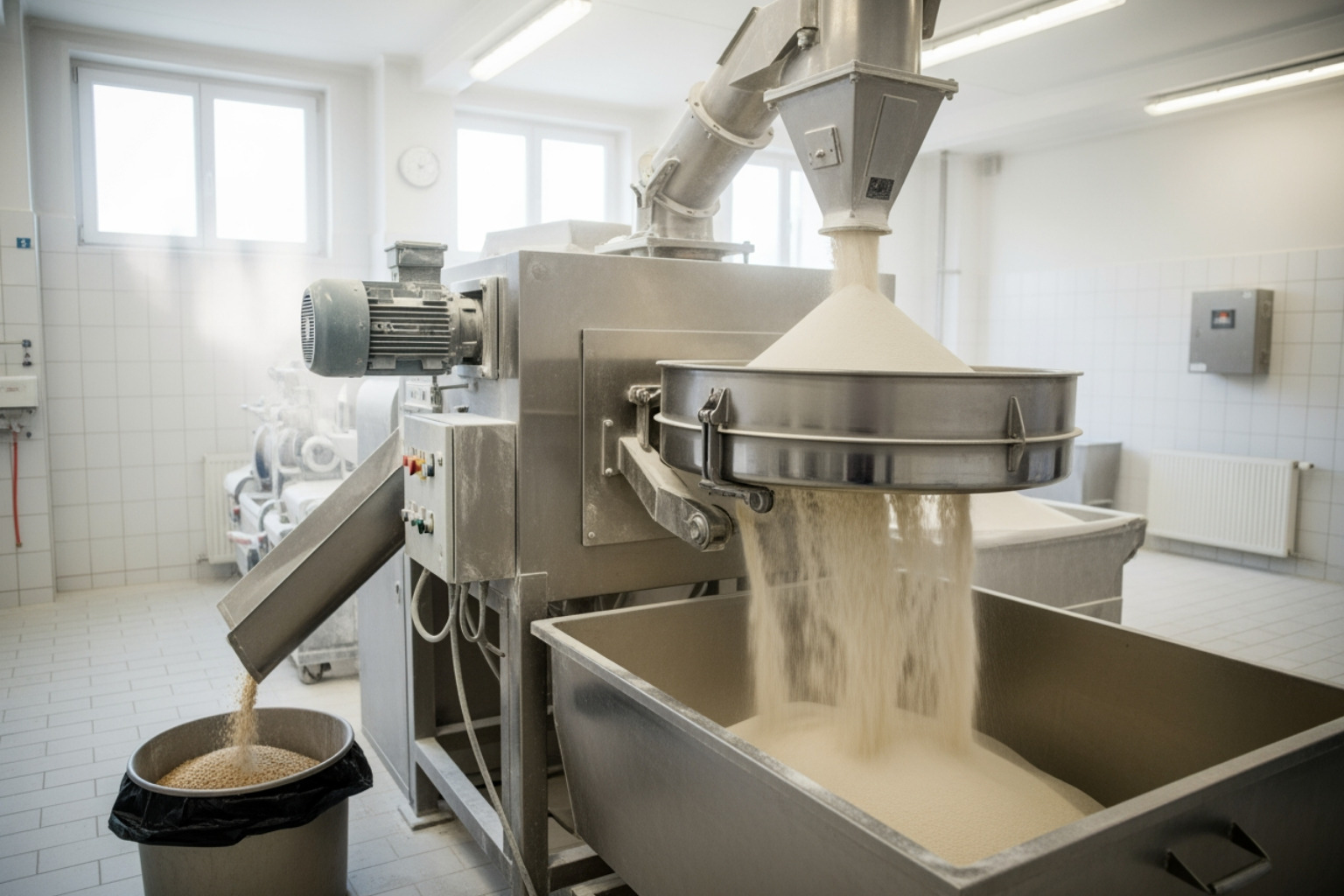
Consider flour sifting, a foundational step in baking. A rotary sifter efficiently removes impurities, lumps, and foreign matter from flour, ensuring a consistent texture and preventing baking inconsistencies. The same principle applies to sugar scalping, where our machines ensure uniform granule size and remove any oversized particles or packaging debris. For spice classification, our sifters precisely separate various spice particles, guaranteeing the desired fineness for different culinary applications. Even in the complex world of cocoa powder processing, our systems are used to achieve the perfect particle distribution and remove any unwanted solids.
Beyond basic separation, our rotary sifters are crucial for safety screening. They efficiently remove foreign materials such as plastics, strings, or even insects that might inadvertently enter raw ingredients during harvesting or transport. This critical step protects both your brand reputation and, most importantly, consumer health. Our Prater Rota-Sieve® systems are designed to integrate seamlessly into your production lines, helping you achieve compliance with stringent food safety regulations.
Find more about the crucial role of these machines in specific applications like Why Use Rotary Sifters for Flour and Real Sifting System Solutions for the Cocoa Industry.
Pharmaceuticals and Chemicals
The pharmaceutical and chemical industries demand an even higher level of precision, purity, and regulatory compliance. Here, our rotary sifters are indispensable for ensuring product integrity and safety.
In pharmaceutical manufacturing, active pharmaceutical ingredient (API) classification is critical. Our sifters guarantee that APIs and excipients (inactive ingredients) meet exact particle size specifications, which directly impacts drug dissolution rates and bioavailability. Similarly, in the chemical sector, our machines are used for de-lumping chemicals and screening various powders to achieve precise particle distribution. This is crucial for applications ranging from catalysts to detergents, ensuring consistent product performance.
One particularly interesting application is in powder coating. Here, a rotary sifter helps to reclaim overspray and remove contaminants, ensuring a smooth, consistent finish and preventing blemishes in the final product. Our systems are designed to handle these fine, often abrasive, materials with ease. Ensuring purity and preventing cross-contamination are paramount in these sectors. Our hygienic design options, including sanitary finishes and construction, allow for easy cleaning and compliance with strict standards like USDA, FDA, and 3-A, essential for sensitive applications.
Learn more about the importance of sanitary design in our Hygienic Design Guide for Rotary Sifters in Sanitary Applications, and see a real-world example in our Powder Coating Sifting Case Study.
Bulk Materials and Minerals
From the aggregates used in construction to the plastics that form everyday objects, the processing of bulk materials and minerals often requires robust and efficient screening solutions. Our rotary sifters are up to the task, handling high volumes and abrasive materials with impressive reliability.
In the field of construction, these machines perform accurate particle size testing on construction aggregates and other granular materials, ensuring they meet specific engineering requirements. For mineral classification, they separate and classify various ores and minerals, which is a crucial step in preparing them for further processing. Our rotary sifters can handle a wide particle size range, from coarse (like 1 inch) down to very fine (like 20µm or No.635 mesh), making them highly adaptable.
Beyond traditional mining and construction, these sifters are also used in plastic pellet screening, ensuring uniform pellet size for extrusion and molding processes. In recycling applications, they help separate different material fractions, contributing to efficient waste management and resource recovery. The robust construction of our rotary sifters ensures longevity and consistent performance even when dealing with abrasive materials, making them a cost-effective solution for high-volume processing in these demanding industries.
Optimizing Performance: Selection, Operation, and Maintenance
At Prater Industries, we understand that investing in industrial equipment is a significant decision. That's why we focus on providing not just machines, but complete solutions that optimize your overall process. Our rotary sifters are designed for seamless system integration, helping you achieve maximum throughput, exceptional product longevity, and unwavering reliability. We believe in maximizing efficiency through every piece of our material processing equipment.
For more on how we help our clients achieve peak performance, read about Maximizing Efficiency Through Prater's Material Processing Equipment.
Key Factors for Selecting a Rotary Sifter
Choosing the right rotary sifter for your specific application is crucial for achieving optimal results. It's not just about getting "a" sifter; it's about getting "the right" sifter. Here are some key factors we consider:
- Material Characteristics: What are you sifting? We look at particle size, density, moisture content, and flowability. Is it a fine powder, a granular material, or something that tends to agglomerate? Our Prater Rota-Sieve® is proven to be cost-efficient in handling a wide variety of powder, granules, agglomerates, and other free-flowing materials.
- Particle Size Requirements: What are your desired "fines" and "overs" sizes? Our rotary sifters can achieve separations ranging from coarse 1/4 inch down to a very fine 200-mesh. The mesh size of the screen is a primary determinant here.
- Capacity Requirements: How much material do you need to process per hour? Our models range in capacity from a few hundred kg/h to an impressive 100 t/h, ensuring we have a solution for both small and large process applications.
- Construction Materials: For many applications, especially in food and pharmaceuticals, stainless steel construction is essential for hygiene and corrosion resistance. We offer various grades of stainless steel to meet your specific needs.
- Sanitary Standards: If your industry demands strict hygiene, compliance with standards like FDA, USDA, BISSC, or 3-A is non-negotiable. Our equipment can be configured with sanitary finishes and designs to meet these rigorous requirements.
We encourage you to consult our Rota Sieve Centrifugal Sifter Data Sheet for detailed specifications that can help guide your selection.
Operational and Maintenance Best Practices for a Rotary Sifter
We design our rotary sifters with an emphasis on low-maintenance and reliability, but even the best machines benefit from thoughtful operational and maintenance practices. Our goal is to make your life easier!
Routine inspection is key to longevity. Regularly checking the screen integrity for any wear or damage helps prevent unexpected downtime. While our machines are known for their robust design, occasional checks of bearing lubrication are also a good idea to ensure smooth, efficient operation.
One of the standout features of our Prater Rota-Sieve® is its ease of maintenance. We've engineered it with a simple design, lightweight parts, and rapid rotor removal, making quick cleaning a breeze. Many components, including the screen, can be accessed and removed without special tools. This tool-free access means less time spent on maintenance and more time producing!
We even have a Quick Clean Rota Sieve Video Series that demonstrates just how simple it is. If you're curious about the specifics, you can even See how to change a screen in a Prater Rota-Sieve. These features significantly reduce the labor and time required for routine upkeep, directly contributing to your operational efficiency.
Safety and Environmental Considerations
Safety and environmental responsibility are paramount in any industrial setting, and our rotary sifters are designed with these considerations firmly in mind. We strive to provide equipment that not only performs exceptionally but also protects your people and the planet.
A major focus is on dust containment. Our rotary screeners feature dust-tight assemblies that prevent dust leakage, creating a safer and cleaner working environment for your operators. This also minimizes product loss and reduces the risk of dust explosions, especially when handling combustible powders. For environments with such risks, our equipment can be designed to meet stringent ATEX directives for explosion prevention. This includes careful consideration of grounding, appropriate electrical equipment for hazardous zones, and features to prevent mechanical sparks.
Operator safety is further improved through robust guarding and safety interlocks. For example, a door safety interlock switch on some models ensures the sifter stops if an access door is opened during operation, preventing contact with moving parts. We also pride ourselves on the low noise operation of our machines, contributing to a more comfortable and less fatiguing workplace.
From an environmental perspective, our efficient designs often translate to energy efficiency, reducing your operational footprint. For more detailed insights into process safety, especially concerning dust explosions, we recommend reviewing relevant Dust explosion safety information. By integrating these safety and environmental features, we ensure our rotary sifters are not just powerful tools, but also responsible additions to your facility.
Frequently Asked Questions
We hear a lot of great questions about rotary sifters, and we love answering them! Here are some of the most common inquiries we receive:
How does a rotary sifter prevent screen blinding?
Ah, the dreaded screen blinding! It's a common issue with many screening methods, but our rotary sifters have a brilliant solution. The combination of high-speed centrifugal force and the continuous action of the rotating paddles creates a dynamic, self-cleaning effect. This constant movement prevents particles from lodging in the screen mesh, effectively sweeping them away. This ingenious mechanism allows for efficient separation down to 200-mesh without requiring separate anti-blinding mechanisms, even when processing materials prone to flaking or agglomerating due to fat or moisture content. It's like having a tiny, tireless cleaner working on your screen all the time!
What is the difference between scalping and sifting?
These terms are often used interchangeably, but they have distinct meanings in particle separation. Scalping is typically a quality control step where the primary goal is to remove a relatively small amount of oversized particles or foreign contaminants (like bits of plastic, string, or insects) from a large volume of otherwise on-spec product. Think of it as a final "clean-up" to protect your downstream equipment or ensure product purity. Sifting, on the other as a more precise term, or classifying, is the process of separating a material into two or more distinct fractions based on particle size, where each fraction is a desired product or component. Both are crucial, but scalping is often about removal of undesirable large particles, while sifting is about precise size categorization.
Can a rotary sifter handle materials that are not free-flowing?
While rotary sifters truly shine with dry, free-flowing powders, their unique de-agglomerating action makes them surprisingly versatile. The rotating paddles and centrifugal force actively work to break down soft lumps and clumps. This means they can be effective for materials with some fat or moisture content that might cause other screeners to bind or clog. However, every material is unique, and for particularly challenging or sticky products, we always recommend material testing at our facility. This allows us to precisely determine the best approach and configuration to optimize your process. We love a good challenge!
Conclusion
From ensuring the purity of your ingredients to boosting your production line's throughput, rotary sifters are indispensable tools for modern processing plants. Their unique centrifugal force advantage translates into superior efficiency, reduced screen blinding, and improved operator safety compared to many traditional screening methods. We've explored how these versatile machines contribute to product quality and process efficiency across critical industries like food and beverage, pharmaceuticals, chemicals, and bulk materials.
By understanding their function, key components, and diverse applications, you're better equipped to select the right equipment to optimize your process. Our commitment at Prater Industries is to provide low-maintenance, reliable systems backed by expert on-site technical services. We're proud to offer solutions that meet the stringent demands of industries across the US and Canada, from Bolingbrook, IL, and throughout Illinois.
Ready to experience the Prater difference? We invite you to Explore our range of Rotary Sifters and find how our advanced separation technology can lift your operations.