

Hammer Mill Screen Physics: Matching Aperture to Particle Size Distribution

A hammer mill screen is the primary control variable in any size reduction system. Before evaluating screen options, engineers need a fast reference for selection logic.
Quick Reference: Screen Selection by Material and Target PSD
| Material Type | Friability | Hole Size Multiplier | Typical Screen Range |
|---|---|---|---|
| Sugar, salts, grains | High | 8x to 10x target particle | 0.3 mm to 3 mm |
| Resins, minerals, chemicals | Average | 5x to 8x target particle | 1 mm to 6 mm |
| Wood, fiber, grain hulls | Low / Hard | 2x to 5x target particle | 3 mm to 12 mm |
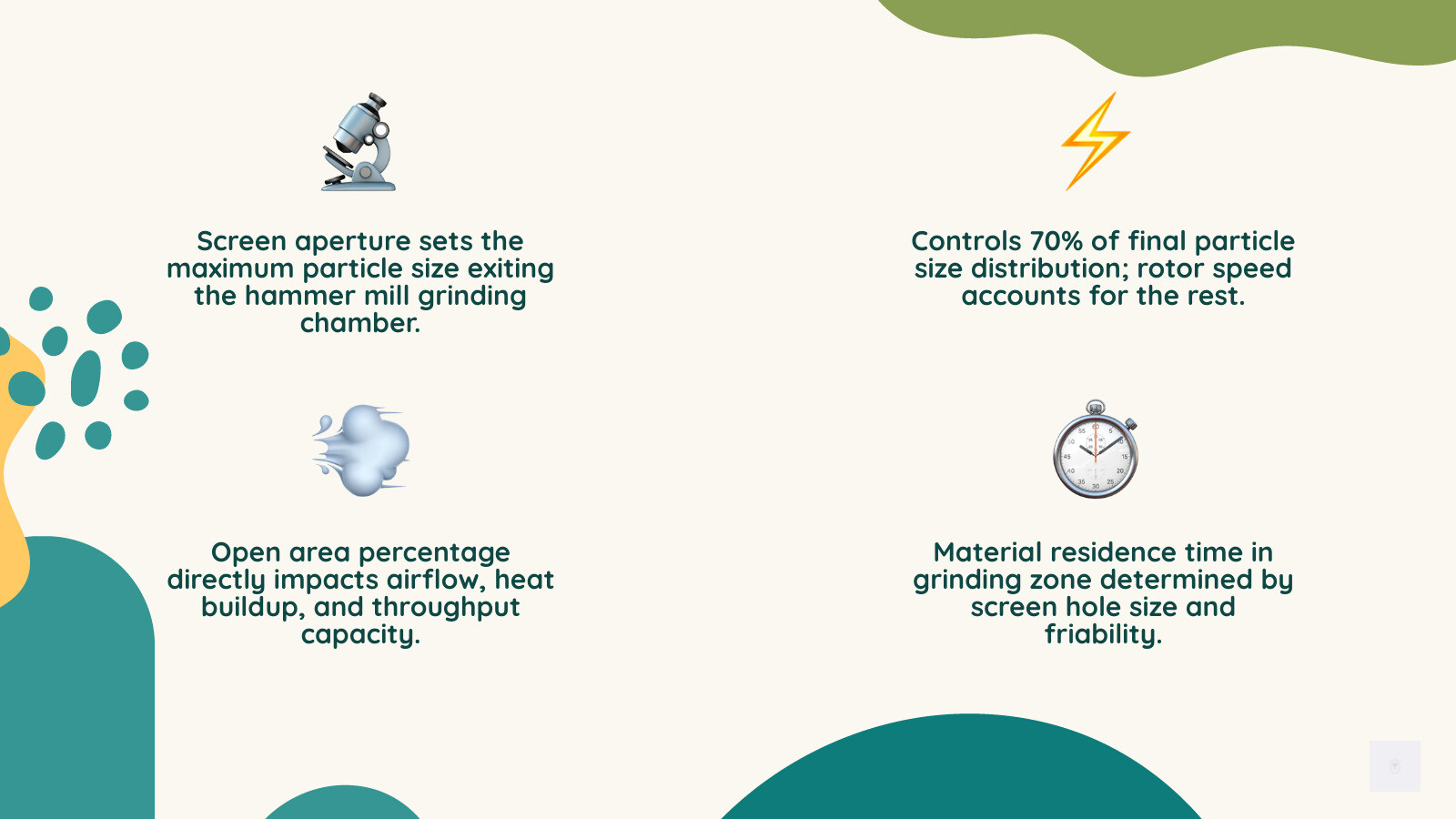
The screen aperture sets the maximum particle size that exits the grinding chamber. It controls roughly 70% of finished particle size distribution, with rotor speed, hammer count, and tip speed accounting for the remaining 30%.
That relationship is not theoretical. It is the physics of residence time: material stays in the grinding zone until it is small enough to pass through the screen opening. A screen that is worn, blinded, or incorrectly specified does not just affect particle size. It affects airflow, heat buildup, motor load, and throughput stability across the entire system.
For operations managing inconsistent grind, rising energy draw, or frequent screen failures, the screen geometry and material specification are almost always the starting diagnostic point, not the hammer configuration.
Prater Industries has applied this process knowledge across a century of real production environments, from feed milling and grain grinding to pharmaceutical processing and industrial recycling. This guide evaluates the screen options, engineering parameters, and selection criteria that matter most for plant-floor decisions.
Selection Logic and Sizing Rules of Thumb
Key Takeaways
- Material friability dictates the ratio between screen hole size and final particle size.
- Highly friable materials (sugar, salt) require larger hole-to-particle ratios (8:1 to 10:1) because they shatter upon impact.
- Fibrous or hard materials (wood, hulls) require tighter ratios (2:1 to 5:1) as they must be physically sheared or torn to size.
- Screen thickness must balance structural integrity with open area percentage to prevent blinding.
Selecting the correct hammer mill screen begins with understanding the physical properties of the feedstock. In industrial milling, we use a "Rule of Thumb" based on the multiplier of the desired particle size. For example, if your target is a 500-micron particle for a highly friable salt, you may actually require a screen with 4 mm or 5 mm openings. This seems counterintuitive until you account for the fact that friable materials do not just "pass through"—they explode upon hammer impact, creating a cloud of fines that easily exit larger apertures.
Conversely, when processing wood or agricultural fibers, the material tends to align with the airflow and "zip" through holes. To achieve a 500-micron wood flour, you might need a 1 mm or 1.5 mm screen. Failing to account for this friability factor leads to over-grinding, which wastes energy and creates excess dust. For a deeper dive into these ratios, consult our Hammer mill screen selection and sizing guide.
Hammer Mill Screen Physics: Impact on Airflow and Residence Time
The screen is more than a filter; it is a pneumatic component. In any hammer mill, the spinning rotor acts as a fan, generating significant airflow. The hammer mill screen provides the resistance against this flow.
Open Area Percentage The "open area" is the total area of the holes divided by the total area of the screen. Standard screens typically range from 30% to 60% open area. A higher open area percentage increases throughput and reduces heat buildup because it allows air to move freely. However, as the open area increases, the structural "bridge" between holes narrows, making the screen more susceptible to warping or tearing under the stress of high-velocity impacts.
Residence Time and Heat If the open area is too low, material remains in the grinding chamber longer than necessary. This increased residence time causes:
- Heat buildup: Sensitive materials like resins or fatty feeds can melt or smear, leading to screen blinding.
- Over-grinding: Particles continue to be struck by hammers, shifting the PSD toward undesirable fines.
- Reduced Throughput: The chamber becomes "choked," increasing motor load and decreasing the kg/h capacity.
Engineering the correct technical parameters for perforated milling screens requires balancing the gauge of the metal with the hole density to ensure the screen can withstand the environment while maintaining the "Release Zone" necessary for efficient evacuation.
Optimizing the Hammer Mill Screen for Specific Materials
Different industries face unique bottlenecks that can be solved through screen optimization:
- Grain Grinding: In livestock feed production, moisture content can cause screens to clog. Using a staggered hole pattern helps distribute the load and prevents the "stapling" of fibers across the openings.
- Glass Crushing: This is an abrasive application where the screen must be thick enough to resist the "sandblasting" effect of cullet while maintaining sharp edges to facilitate fracturing.
- Wood Processing: When turning scrap wood to wood flour, the goal is often to maximize surface area. Slotted screens are frequently used here to allow longer fibers to be oriented and sheared.
- E-Waste Recycling: Modern shredding e-waste and recycling systems deal with a mix of plastics and metals. Screens must be heavy-duty (often 1/4 inch or thicker) to handle the impact of non-friable components like copper wiring or aluminum housings.
Screen Geometry Selection: Round Hole vs. Conidur for Specialized Resins
The shape and orientation of the perforation change how material interacts with the screen surface.
- Round Hole Perforations: The industry standard for dry, free-flowing materials. They offer the best balance of strength and open area.
- Slotted Screens: Essential for fibrous materials (alfalfa, straw, wood chips). Slots prevent the "bridging" that occurs when long fibers lay across round holes.
- Conidur (Raised Surface): These screens feature a "burr" or a raised edge on one side. When the burr faces the material flow, it acts as an additional cutting surface. This is ideal for hard, friable materials or specialized resins that require a finer grind without increasing rotor speed.
- Herringbone Patterns: A zig-zag layout that ensures no "dead zones" exist on the screen surface, promoting uniform wear across the hammers and the screen itself.
Comparison of Screen Geometries
| Geometry | Primary Benefit | Common Application | Wear Resistance |
|---|---|---|---|
| Round Hole | High Open Area | Grains, Chemicals | Moderate |
| Slotted | Prevents Clogging | Wood, Fibrous Ag | High |
| Conidur | Fine Milling | Pharmaceuticals, Resins | Very High |
| Herringbone | Even Wear | High-Volume Feed | Moderate |
For specialized applications, the orientation of the burr edge is a critical technical decision. Facing the burr into the flow increases the "cutting" action but accelerates wear. Facing it away from the flow provides a smoother release for sticky or high-moisture materials.
Custom Hammer Mill Screen Features and Materials
To combat specific process challenges like abrasion or corrosion, we utilize a variety of metallurgical options:
- AR 400 Steel: An abrasion-resistant alloy designed for high-impact environments like mining or heavy recycling.
- 304 and 316 Stainless Steel: Required for food-grade, pharmaceutical, or corrosive chemical applications where carbon steel would contaminate the product.
- Thickness Range: We stock and manufacture screens from 24 gauge (thin, high-release) up to 5/8 inch (heavy industrial).
- Chrome Plating: Applied to carbon steel screens to provide a low-friction surface that resists blinding in "sticky" applications.
- Beveled Edges: Custom frames and bevels ensure the screen sits flush against the mill housing, eliminating "leakage" where oversized particles might bypass the grinding zone.
Using these materials is essential when processing abrasive materials with specialized screens, as it extends the interval between maintenance shutdowns.
Quantifying Maintenance: Failure Signals and Replacement Metrics
Waiting for a screen to "break" is a recipe for catastrophic system failure. Instead, operators should monitor diagnostic data to determine the replacement interval.
1. Motor Amperage Increase (10–15%) If your motor amperage rises by 10–15% while maintaining a consistent feed rate, the screen is likely blinded or the hole edges have rounded. Rounded edges lose their ability to "catch" and shear material, forcing the hammers to do more work through pure impact, which draws more power.
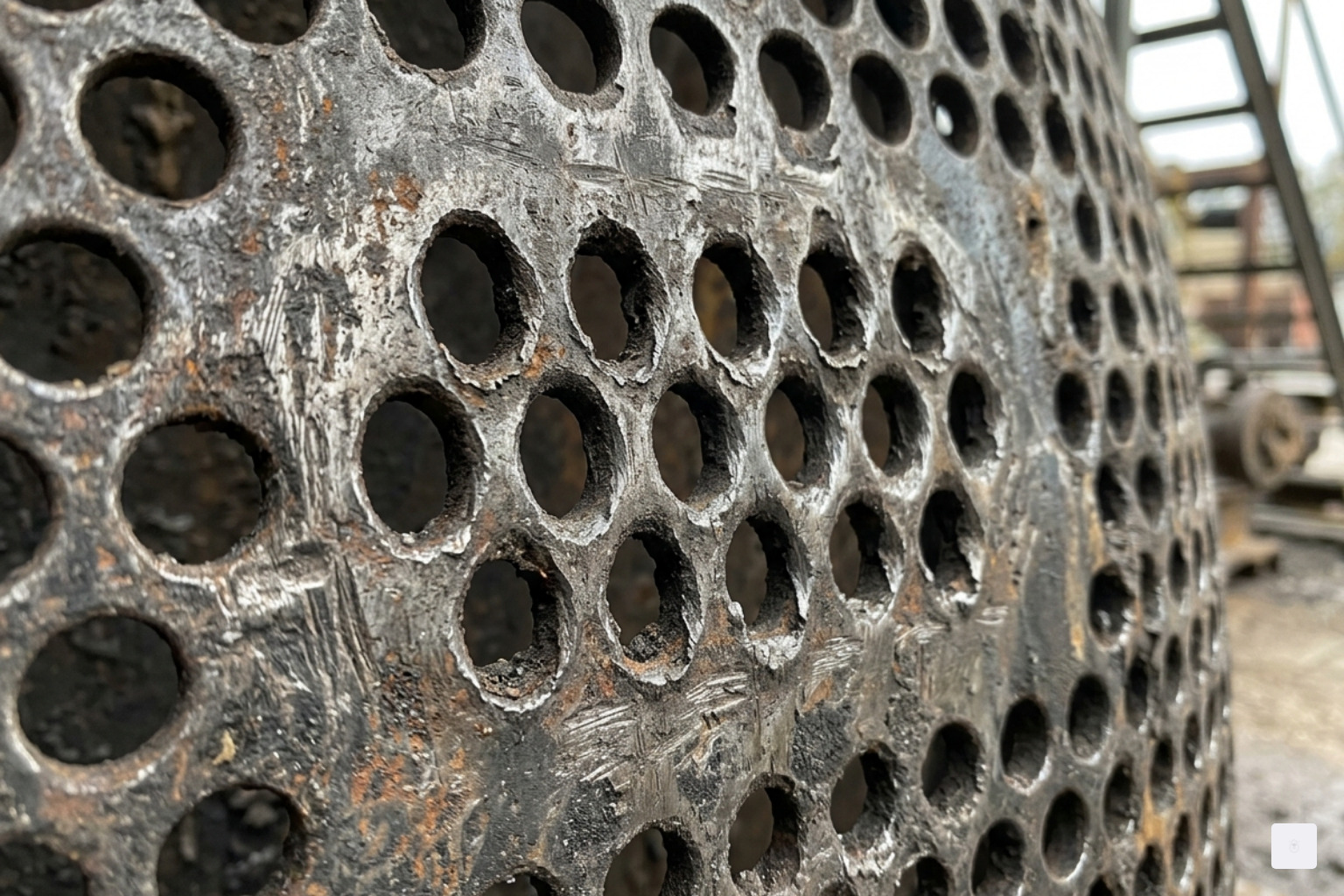
2. Hole Elongation (5% Threshold) The standard engineering threshold for replacement is 5% hole elongation. If a 10 mm hole has worn into an 10.5 mm oval, the PSD will drift significantly. This allows oversized particles to pass, potentially damaging downstream equipment like pellet mills or extruders.
3. Visual Signals: Warping and Tears During routine inspections, look for "washboarding" or warping. This indicates the screen has been stressed by a foreign object or a "slug" of material. A warped screen changes the hammer-to-screen clearance, leading to uneven grinding and localized heat buildup.
Maintaining a rigorous schedule and maintaining an inventory of critical spare parts ensures that a $500 screen doesn't cause $50,000 in lost production time.
Engineering the Release Zone: Full Screen Design Advantages
In traditional hammer mills, the screen only covers the bottom 180 degrees of the grinding chamber. This creates a "dead zone" in the top half of the mill where material continues to circulate, getting hit by hammers repeatedly without an opportunity to escape.
Prater’s Full Screen Hammermill engineering utilizes a design that expands the screen coverage to 270 degrees or more. This significantly increases the "Release Zone."
Technical Advantages of the Full Screen Design:
- Prevention of Over-Grinding: By providing more "exit doors," particles leave the chamber the moment they reach the target size.
- Reduction of Fines: Minimizing the time a particle spends in the chamber reduces the chance of it being pulverized into dust.
- Lower Temperature: Increased evacuation area means more airflow, which keeps the internal temperature lower—a critical factor for heat-sensitive food products and chemicals.
- Increased Capacity: With more usable screen area, the mill can process more material per horsepower, improving the overall ROI of the installation.
Frequently Asked Questions about Hammer Mill Screens
How does screen thickness affect milling efficiency?
While a thicker screen is more durable, it can actually decrease efficiency. A thicker plate creates a deeper "tunnel" for the particle to travel through. If the material is slightly sticky or fibrous, it is more likely to get caught in a 1/2 inch thick hole than a 1/8 inch thick hole. We recommend using the thinnest gauge that can safely withstand the impact force of your specific application.
What is the difference between a screen and a bar grate?
A hammer mill screen is a perforated plate with specific hole sizes, used for fine to medium grinding. A bar grate consists of heavy steel bars spaced at specific intervals. Bar grates are used for primary crushing or heavy-duty applications (like scrap metal or large wood chunks) where a perforated plate would be destroyed by the impact.
Why is the open area percentage critical for throughput?
Open area is the "breathing capacity" of your mill. If you have 20% open area, 80% of the screen surface is solid metal that material just bounces off of. Increasing to 50% open area more than doubles the opportunities for a particle to exit, which directly correlates to a lower motor load and higher throughput.
Conclusion
Optimizing a milling process is not just about the horsepower of the motor or the weight of the hammers; it is about the engineering of the "Release Zone." The hammer mill screen is the gatekeeper of your product quality and process efficiency. By understanding the physics of residence time, applying the correct sizing multipliers, and monitoring wear metrics like hole elongation, plants can achieve a more stable PSD and lower operational costs.
At Prater Industries, we don't just provide replacement parts; we provide applied engineering solutions based on a century of process knowledge. Whether you are processing abrasive minerals or delicate food ingredients, our Industrial Hammermills are designed to maximize your uptime and product consistency through superior screen technology.